From Lab to C-Suite: Building the Manufacturing and Finance Leadership for a VC-Backed Fusion Pioneer
The Challenge
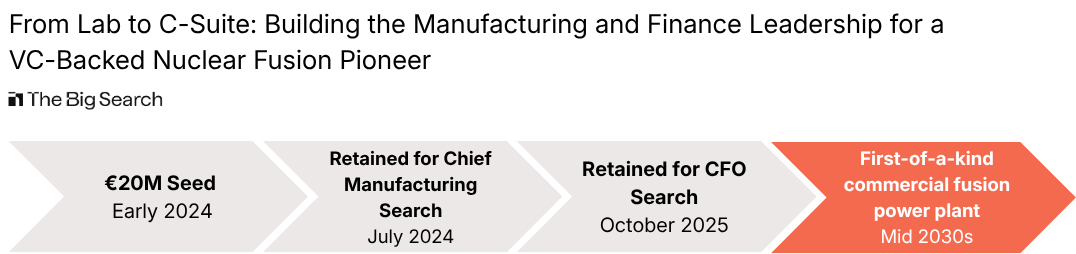
The company is a fusion startup founded in 2023 by a team of physicists and engineers spun out of one of Europe's leading plasma physics research institutes. Its mission: to deliver limitless, clean fusion energy to the grid in the 2030s. By mid-2024, it had closed over €27M in pre-seed and seed funding. A year later it completed Europe's largest private fusion investment round at €145M Series A (+ extension), bringing total funding to €200M. It now employs over 100 people across offices in three countries.
The scientific case was made. What the company needed was the executive infrastructure to turn a world-class research programme into a hardware-execution programme and eventually into a commercially viable energy business. That meant two very different hires at two very different moments.
They turned to The Big Search for both.
Overview of the Two Executive Searches
Between July 2024 and April 2026, The Big Search partnered with this fusion startup to build two of its most critical C-suite appointments: a Chief Manufacturing Officer to lead the transition from research to hardware execution, and a Chief Financial Officer to manage a €200M institutional capital base through a pre-revenue, decade-long commercialisation roadmap. These were not sequential interventions. They were two different hiring problems, separated by fifteen months, requiring entirely different talent pools and search strategies. We closed both.
Phase 1 — Anchoring the Hardware Programme: Chief Manufacturing Officer
July 2024 → November 2024 | VC Value Creation: Science-to-Business Transition Phase
At the point this search opened, the company was a pre-revenue deep-tech startup operating at the earliest stage of hardware development. Its team was built almost entirely of physicists, engineers, and researchers. The scientific foundation was world-class. The manufacturing infrastructure was not yet built. The Chief Manufacturing Officer would be the first senior executive hired specifically to change that. They would own the entire manufacturing strategy, build the function from zero, and translate research outputs into a repeatable, precision hardware programme.
The challenge was not only finding a manufacturing leader of sufficient calibre. It was finding one willing to leave a senior role in a mature, well-resourced industrial environment to take on a hardware challenge that had no commercial precedent. Most executives who have reached this level in aerospace, automotive, or medical devices are embedded in large programmes with established teams, budgets, and infrastructure. The pitch required a very specific kind of appetite.
Executive Search Across European Precision Manufacturing and Hardware Scale-Up Leadership
The hunting strategy was built around three industrial sectors with the closest analogue to what fusion hardware requires: high-performance commercial aerospace and launch technology, premium automotive manufacturing, and surgical or precision medical device production. All three demand extreme tolerances, complex multi-component assembly, and the ability to build processes at the intersection of engineering science and industrial execution. Specifically, the search targeted:
- VP Manufacturing and COO profiles at commercial aerospace companies operating at the frontier of launch technology
- Senior manufacturing leaders from premium automotive groups with deep hardware engineering programmes
- COO and VP Operations profiles at fast-scaling surgical robotics and precision medical device companies
- Candidates with a demonstrated track record of moving between large-scale industrial environments and high-growth hardware startups
We undertook an exhaustive mapping exercise across Europe, identifying 125 candidates. The client interviewed 8.
The Placed Candidate: A Manufacturing Executive With a Career Built Across Aerospace, Automotive, and Surgical Robotics
The future Chief Manufacturing Officer came to the role with a career built in industries where the cost of manufacturing failure is measured in lives and programmes. Their foundations were laid at one of Germany's leading premium automotive manufacturers, where manufacturing rigour is foundational. From there they spent over seven years at a global commercial aerospace company during one of the most aggressive hardware scale-ups in modern industrial history. They then stepped into a Chief Operating Officer role at a surgical robotics scale-up, bringing the same precision manufacturing discipline into an early-stage, VC-backed hardware context.
Why they fit:
🏭 Hardware scale-up experience at the most demanding level — seven years inside a global commercial aerospace company, scaling manufacturing from early development through to high-cadence production, is the closest existing training ground for a fusion hardware programme
🔩 Three-industry manufacturing depth — automotive, aerospace, and surgical robotics: each sector requires extreme precision, zero tolerance for failure, and the ability to build processes from scratch
🚀 Proven startup transition — the surgical robotics COO role demonstrated they could take what they learned inside large industrial environments and apply it inside a scaling pre-commercial business, which is exactly the transition this role required
🎯 Builder, not maintainer — a career defined by creating manufacturing capability rather than managing inherited infrastructure; at a company building something that has never been commercially built before, that distinction is decisive
Phase 2 — Installing the Financial Architecture: Chief Financial Officer
October 2025 → April 2026 | VC Value Creation: Science-to-Business Transition Phase
By October 2025, the company had closed its €145M Series A (+extension) and was managing a cumulative institutional capital base of €200M. The CFO search opened against a specific set of conditions: a board structure including some of Europe's most prominent deep-tech investors, a commercialisation roadmap measured in decades rather than quarters, and a business that was entirely pre-revenue. That combination demands a very specific financial profile.
The CFO needed to understand how deep-tech capital cycles work, how to report progress against a long-horizon roadmap, and how to maintain investor confidence through a sustained period of heavy capital expenditure without commercial milestones to point to. There was an additional requirement: the candidate needed to be capable of managing the eventual transition to revenue, licensing, or energy offtake structures when the time came. That made pure operational finance experience insufficient. The role required someone with institutional capital markets experience alongside their operating CFO track record. That intersection is narrow.
Executive Search Across European Deep-Tech Finance and Institutional Capital Markets
Two pools were defined. The first: CFOs and finance leaders at VC-backed deep-tech and climate-tech companies across Europe who had managed large institutional capital bases through pre-revenue phases. The second: senior investment bankers and capital markets professionals with direct technology or energy transaction experience who had crossed into operating CFO roles at VC-backed companies. The thesis was that the right candidate needed both lenses. A career finance executive without capital markets experience would not be credible with this investor base. A banker who had never run a finance function would not be able to build one. The search targeted the intersection. Profile criteria targeted:
- CFOs at VC-backed deep-tech, climate-tech, or energy-tech companies operating at pre-revenue or early-revenue stage with large institutional balance sheets
- Investment bankers with 10+ years of coverage across technology, energy, or specialty finance who had made the transition into operating CFO roles
- Finance leaders with board-level credibility and direct investor relations experience at Series A and beyond
- Candidates with multi-geography European capital markets execution experience
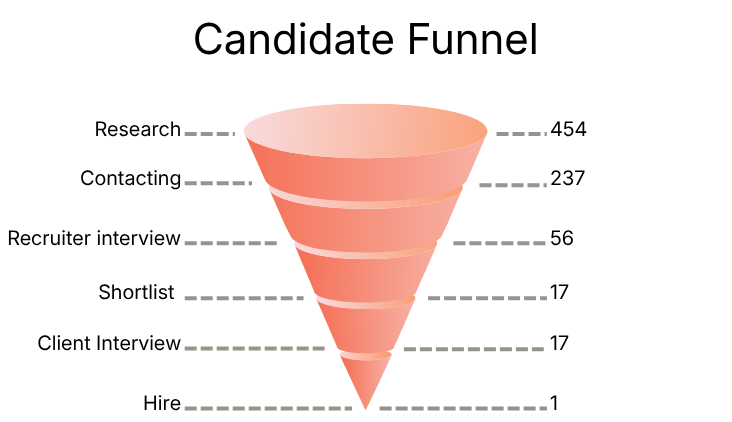
We undertook an exhaustive mapping exercise across Europe, identifying 454 candidates.
⏱ Days to first shortlist delivery: 7 days from kick-off
⏱ Days to first shortlist delivery: 7 days from kick-off
The shortlist of 17 candidates was presented to the client seven days after the search opened. What followed was a rigorous, methodical client interview process: all 17 shortlisted candidates proceeded to interview. The search ran 177 days in total. The process was thorough, not slow.
The Placed Candidate: A Deep-Tech CFO With 15 Years of Investment Banking Before the Operating Seat
The future CFO built their career in two distinct phases. The first: over 15 years as an investment banker focused on FinTech, Specialty Finance, and Banking, executing M&A, Equity Capital Markets, private capital raises, and liability management transactions across Western Europe, Emerging Europe, and the Middle East. The second: a move into venture, then into the CFO seat at a European digital health unicorn, where they ran the finance function through a period of rapid institutional scale. They arrived at this role with the investor relationships, the capital markets literacy, and the operating finance credibility the position required.
Why they fit:
💼 15+ years of investment banking before the CFO seat — most CFOs at this stage have either the banking background or the operational background; this candidate had both, in sequence, at depth
🏥 Ran finance at a European digital health unicorn — the move from senior investment banker to operating CFO at a high-profile, VC-backed company demonstrated the ability to build and manage a finance function, not just advise one
🌍 Multi-geography capital markets execution — transactions across the UK, Western Europe, Emerging Europe, and the Middle East provide the range needed to navigate an international deep-tech investor base
🔮 Pre-revenue capital cycle fluency — understanding how to communicate a decade-long commercialisation horizon to institutional investors, manage a heavy capex balance sheet, and maintain board confidence without near-term revenue milestones is a specific capability; their investment banking background and unicorn CFO experience provided both sides of it
Science-to-business transitions don't stall because the science fails. They stall because the executive layer isn't ready to execute.
This company got it right. Two mandates, two C-suite hires, two completely different talent pools. A Chief Manufacturing Officer sourced from the intersection of commercial aerospace, premium automotive, and surgical robotics. A CFO with 15 years of investment banking behind them before they ever ran a finance function.
The reality of both searches is the same: the profiles that exist on paper are rarely the profiles that say yes. A manufacturing executive trained inside a global aerospace scale-up who will step into a pre-commercial fusion hardware programme is not a common breed. A CFO who combines institutional capital markets depth with an operating finance track record and the appetite for a decade-long pre-revenue roadmap is rarer still. Finding them requires knowing exactly where to look, and making a compelling case when you do.
If you are building a leadership team around a science-to-business transition and need the right people in place before your next raise, let's talk.